The Human-AI Readiness Assessment
AI does not fix an unclear business. It amplifies it.
Two companies run the same software and get completely different results. The difference is almost never the technology — it is whether the business underneath is clear enough to build on. Find the one part of yours that is not, in about six minutes.
















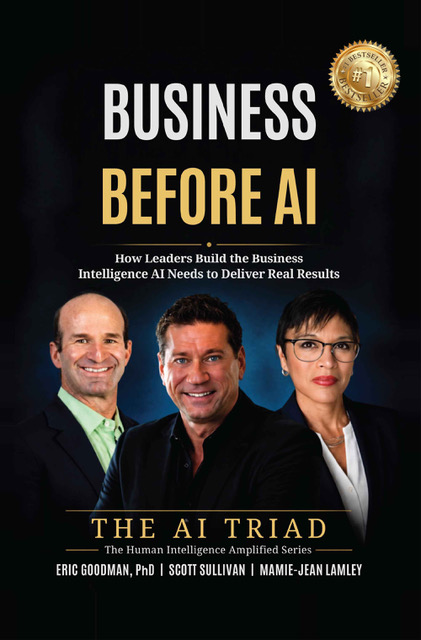
The book
Business Before AI
How Leaders Build the Business Intelligence AI Needs to Deliver Real Results
Eric Goodman, PhD · Scott Sullivan · Mamie-Jean Lamley
The assessment on this site is the one in the book. It opens with the same six questions and closes with the same eighteen statements — and each of the six dimensions maps to a chapter, so your primary constraint tells you where to start reading.
The first title in the Human Intelligence, Amplified series.

In about six minutes
What you will actually learn.
No promised savings number, no rank against other companies. A diagnosis you can act on this week.
Your readiness profile
Where you are strong, where you are exposed, across all six dimensions.
Your primary constraint
The single area most likely limiting results — read against the outcome you name.
One specific next move
Not a list. One thing, written for your situation.
The chapter to read first
Each area maps to a chapter of Business Before AI. Your constraint tells you where to start.
A one-page brief
Emailed to you, written to go in front of your leadership team without editing.
Whether a review fits
If a thirty-minute Readiness Review would help, you will know — no pitch attached.
The problem
Most AI advice starts with the tool.
So businesses buy the tool, the results are uneven, and nobody can quite say why. The answer is usually upstream: the result was never defined, the process changes depending on who runs it, the current pricing lives in three places, and nobody decided what may be sent to a customer without a person reading it. None of that is a technology problem — all of it becomes expensive the moment software is asked to help.
Three simple steps
Six minutes, start to profile.
Six questions first
Yes or no, thirty seconds, no email. Not scored — they show you whether there is anything worth measuring.
Then eighteen statements
Pick one repeated process and rate how work actually happens. One tap each.
Your profile, immediately
On screen, then in your inbox. Details asked at the end, not the beginning.
The four profiles
Which describes your situation?
None is a pass or a fail. They describe different starting points — a situation, not a verdict on you. The most common one is somewhere in the middle.
Foundation First
The result is not yet defined, or the work is not yet clear enough to improve.
Ready to Test
Enough is in place to try one meaningful opportunity and learn from it.
Ready to Scale Selectively
Real capability exists. The task is to scale what has earned the right to scale.
Ready to Amplify
The business is clear underneath. Now AI can compound what is already working.
How we work
Six things diagnose. Five steps install.
The six dimensions tell you which thing is in the way. These five are what we do about it, in order — because skipping ahead is the single most common reason AI work quietly stops being used.
Work with us
We start with a diagnosis, not a proposal.
Every engagement below answers one specific constraint. Which one you have is not a matter of opinion — it is the output of a six-minute assessment, and it decides what is worth doing first.
If you have not taken the assessment, start there.
Not as a formality. Everything below is chosen against a constraint, and choosing without one is how businesses end up buying a workshop for a problem that was never in the room. It takes six minutes and the first six questions cost you nothing but thirty seconds. Begin the assessment.
The routing
Six constraints. Six different first moves.
The assessment returns one primary constraint — the area most likely limiting what AI can do for you. Here is what usually answers each. Find your own and start there.
Ways to work together
Four engagements, in order of commitment.
Each one states what it is, who it suits, how long it takes, and what it costs.
Readiness Review
NO CHARGEYour profile read against your actual business, by the people who built the framework. Named participants, a real agenda, and no obligation on either side.
Executive Briefing
$1,500For Leadership and Governance constraints, where the problem is not capability but agreement. We work the six dimensions against your business with the people who can actually decide.
- A stated result and a named owner for it
- Boundaries: what AI may do, and what requires a person
- The first process worth changing, and why that one
AI Build Day
$397 VIRTUAL · $997 IN PERSONFor Process and Context constraints. You bring one piece of repeated work and leave with it written down, built, and tested against real cases.
- Your business context, written down
- An assistant built against one real process
- Three test cases run, and a receipt
The Accelerator
FROM $2,500For Context and Measurement constraints, and the step after a Build Day. What was built is installed, tested against real cases, and measured — verification is the spine. Application-based, so each cohort is selected rather than sold.
For teams and organizations
When the constraint is not yours alone.
Team Build Day
One team, one day, private. Their processes, their context, their standards.
Department Sprint
Six weeks inside one function. Installed, verified, and handed over.
Fractional AI Advisor
Decisions, sequencing, and build oversight without a hire.
How we measure it
Every engagement ends in a receipt.
Not a certificate and not a summary. A short record of what changed, with the evidence attached, written so it can be checked by someone who was not in the room. We collect it at the end of the work, and again at thirty, sixty and ninety days — because the question that matters is not whether something was built, but whether it is still running. No invented testimonials, no numbers we cannot show you the evidence for.
What we do not do
Stated now, so nobody is surprised later.
- We do not build systems that act without human approval. Every workflow we install has a person in it, on purpose.
- We do not promise a savings number — or how many hours you will save — before we have looked. Anyone quoting a number in advance is guessing.
- We do not take work whose stated objective is replacing people. That is a different engagement and a different firm.
- We do not rank you against other companies, or assign a label you would be embarrassed to repeat.
- We do not use unnamed testimonials or unpermissioned logos, anywhere.
- We do not claim results we cannot show you the evidence for. That is what the receipt is.
Where to start
Find out where the gap is.
Start with six questions that take thirty seconds and cost you nothing — then decide whether the rest is worth your time.